



- Fixed Income Strategist

The views expressed are those of the authors at the time of writing. Other teams may hold different views and make different investment decisions. The value of your investment may become worth more or less than at the time of original investment. While any third-party data used is considered reliable, its accuracy is not guaranteed. For professional, institutional, or accredited investors only.
Today’s market participants often lament that credit spreads are too compressed. Indeed, in many cases, spreads — having reached the top percentile in historical tightness across some sectors — may offer little upside potential. However, several disparate factors tend to drive total returns in fixed income and explain why spreads could remain in this lower range for some time.
Focusing too narrowly on spreads and awaiting a mean reversion toward more attractive levels could cause investors waiting on the sidelines to forgo some compelling investment opportunities. Investors should be aware of several key factors that may drive their fixed income returns in the current environment:
1. Spread dispersion
Despite tight spreads across some sectors at the index level, dispersion is still fairly wide in spreads among different sectors and individual issuers. And there’s no shortage of potential drivers of spread volatility, including diverging central bank monetary policy, continued geopolitical conflict, and volatile US fiscal policy. Further dispersion among credit sectors would present more attractive entry points to add risk, in our view.
In fact, certain spread sectors, such as bank loans, collateralized loan obligations (CLOs), and commercial mortgage-backed securities (CMBS) remain attractive from a longer-term spread perspective. Many of these asset classes can be accessed through either standalone investments or multi-asset credit strategies.
2. Elevated yields
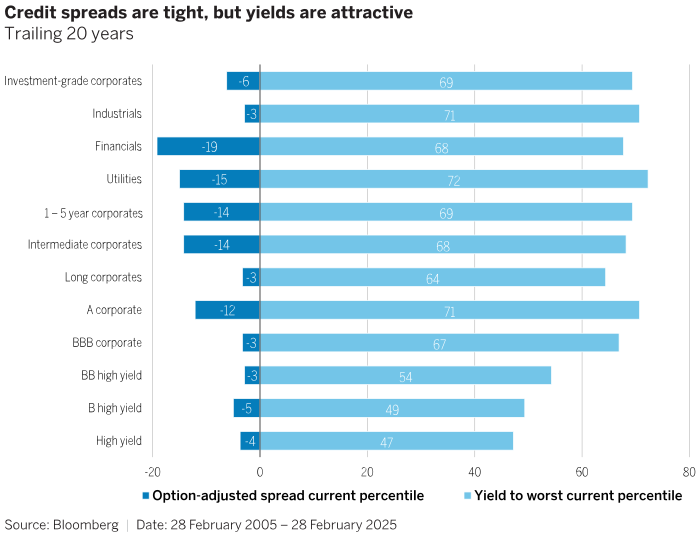
Yields remain near the high end of the range, and look reasonably attractive from a longer-term, historical-percentage basis. And given the relative flatness of the yield curve, fixed income investors don’t need to take on significant duration risk to find attractive yield opportunities. Figure 1 shows that while the historical spread percentile across credit segments ranks at the tightest extremes, yields look much more attractive.
Figure 1
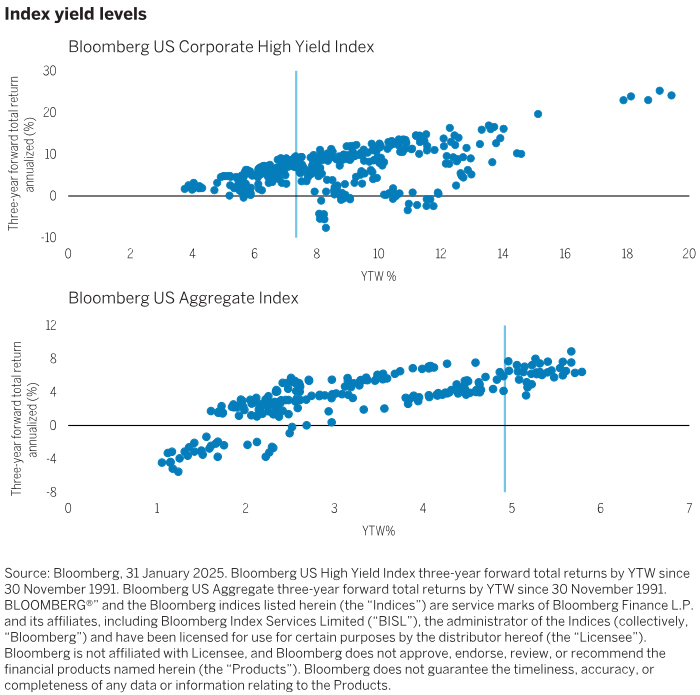
Importantly, one of the single most significant drivers of expected returns for a fixed income portfolio is the starting yield. Figure 2 depicts the ending yield-to-worsts (YTWs), or the lowest potential yield that an issuer can pay on a bond without defaulting, of several fixed income indices on a historical basis. Each dot represents monthly observations of YTW and the Y axes show the corresponding annualized return over the ensuing three years. The blue bars represent the index yield levels as of 31 January 2025. Note the general upward sloping shape of returns versus starting yields.
Figure 2
3. The “risk-off” factor in yields today
When interest rates were low and approaching the zero lower bound, the recessionary risk mitigation of the underlying Treasury rates in credit was relatively low, unless one assumed that interest rates could move into negative territory. In today’s elevated yield backdrop, the underlying Treasury yield can act as more of a potential “shock absorber” through risk-off cycles that move spreads wider.
4. Added value through active management?
Finally, if yield alone isn’t a significant inducement, flexible total return fixed income strategies can toggle risk on and off, depending on the manager’s assessment of relative valuations and return skew. In our view, attractiveness of valuations may continue to diverge across fixed income sectors, creating potential opportunities for dynamic strategies that can take advantage of security or sectoral dislocations.
Given the uncertainty of the current rate cycle — a dynamic compounded by persistent geopolitical risks — we believe a prudent approach to fixed income allocations may be maintaining a benchmark-agnostic approach with flexibility to pursue security- or sector-dislocation-driven opportunities as they arise.


















Monthly Market Review — August 2026
A monthly update on equity, fixed income, currency, and commodity markets.
By