


- Fixed Income Portfolio Manager & Credit Analyst

The views expressed are those of the author at the time of writing. Other teams may hold different views and make different investment decisions. The value of your investment may become worth more or less than at the time of original investment. While any third-party data used is considered reliable, its accuracy is not guaranteed. For professional, institutional, or accredited investors only.
Convertible bonds outperformed most fixed income sectors over the last two years, but we see additional upside as we move further into 2025. Given historically tight spreads, we believe convertible bonds offer attractive relative value versus credit.
We’re more sanguine on the macroeconomic landscape and anticipate continued positive growth this year. However, we see some signs of inflationary pressures, which may result in a higher-for-longer interest-rate environment or a return to US Federal Reserve interest-rate hikes. Despite our rosy growth outlook, we believe the scope for capital appreciation is limited in fixed income markets. Unlike traditional fixed income securities, convertible bonds can add convexity to portfolios given the equity upside while also seeking to provide downside protection in an equity sell-off scenario with the inherent bond floor.
Attractive total return potential relative to broader fixed income
Corporate credit spreads are near all-time tight levels, and we don’t believe there is significant capital appreciation potential. Instead, we believe income will drive 2025 forward returns for investment-grade and high-yield corporate bonds. At the time of writing, convertible bonds yield around 3.0% and provide upside potential because of the equity option embedded in the instruments. Going forward, the asset class may be able to achieve high single-digit total returns, and we believe it’s possible to add value over the benchmark indices through bottom-up, fundamental credit selection.
Anticipate convergence with large-cap stocks
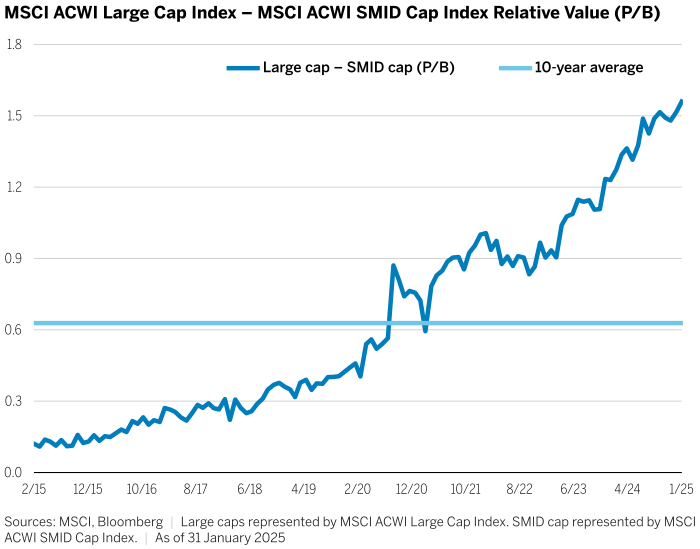
Large-cap stocks have outperformed most of the investment universe over the last two calendar years. Although the Magnificent Seven tech companies have driven most of this, the broader large-cap cohort has still significantly outperformed small- and mid-cap issuers. As illustrated in Figure 1, we’ve seen notable divergence in small- and mid-cap (SMID) and large-cap valuations recently. Overall, SMID stocks are more representative of convertible bond issuers. We believe convergence in the performance of other equities outside these seven dominant companies is possible, particularly in non-US converts, which remain attractive.
Figure 1
Higher-quality asset class with good fundamentals
While we acknowledge much of the convertible bond market remains unrated, our research indicates the average credit rating of the market is BB. Additionally, we saw increasing investment-grade-rated issuance in 2024, which we believe could provide the market with stronger insulation in a downside scenario. From a fundamental perspective, corporate earnings remain relatively strong, and we believe corporate fundamentals are relatively safeguarded from the potential impact of a shift to tighter monetary policy. The environment remains ripe for buybacks and is increasingly favorable for M&A activity, which can be an opportunity for convertibles given the equity upside participation.
Exposure to growth-oriented sectors
Convertible bonds offer exposure to “secular winners” and industry leaders, which continue to benefit from innovation and growth. For example, the global convertible bond market is weighted toward more growth-oriented sectors, such as technology, financials, health care, and internet and data — sectors not well represented in the traditional corporate universe. The asset class provides the opportunity to gain upside exposure to major themes like cybersecurity, AI, and health care innovation.
We continue to make the case for convertible bonds
Overall, we believe 2025 is shaping up to be another strong year for convertible bonds. We continue to see a compelling case for the asset class on a stand-alone basis or as a diversifying component of a broader fixed-income allocation. Recently, we’ve seen heightened volatility as disruption in AI has resulted in increased dispersion, providing greater opportunities to add value through credit selection. Going forward, we believe a reasonable yield combined with equity participation, potentially aided by prudent security selection, could generate an attractive total return for a convertible bond allocation in 2025.

















Monthly Market Review — August 2026
A monthly update on equity, fixed income, currency, and commodity markets.
By