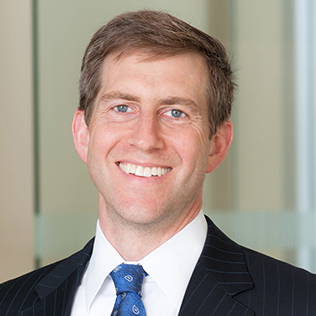


- Fixed Income Portfolio Manager
The views expressed are those of the speaker at the time of filming. Other teams may hold different views and make different investment decisions. The value of your investment may become worth more or less than at the time of original investment. While any third-party data used is considered reliable, its accuracy is not guaranteed. For professional, institutional, or accredited investors only.
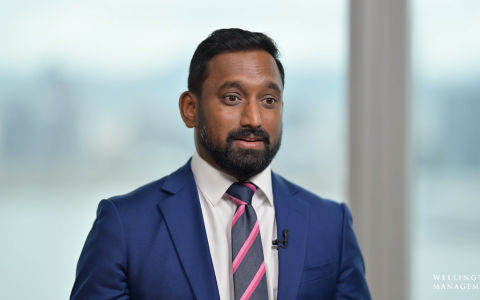
In this edition of “Rapid Fire Questions”, fixed income portfolio manager Campe Goodman shares his views on 4 key questions.
Question: What’s your take on recent market volatility and rates outlook?
Trump policy, particularly tariffs, has introduced some uncertainty into the growth outlook. I think the combination of relatively strong US growth along with slightly easier monetary policy combined with some uncertainty about what the administration is going to do means that rates should end up being actually relatively steady in coming months
At the same time, we think that there are going to be dislocations in the credit markets that are introduced as a result of the tariffs, and other types of actions from the government that are going to cause some uncertainty in credit markets.
My goal is to take advantage of these by extending out our duration, and by looking for opportunities in markets we're keeping, more cash than usual and more high-quality securities in order to buy dislocated opportunities as they appear.
Question: What are your 1-2 highest conviction ideas right now?
So there are two areas that I'm really focused on right now. One is in the US and that's in the structured finance markets. We are finding really good opportunities in residential mortgage securities, parts of the commercial mortgage backed securities market, and in certain parts of the asset backed security market, most notably in subprime auto loans. Outside the US, where we're seeing the best opportunities are in emerging market corporates. We're finding that there are a lot of EM ideas that have relatively steady cash flows, even though they're located in interesting countries. So, for example, we're looking at cell tower and mobile companies in Africa, we're looking at water and sanitation in Brazil, we're looking at energy companies in Asia. All of these are opportunities that really fit that theme.
Question: What are the risks to look for in the next 6-12 months?
So in the next 6 to 12 months, one of the big risks that we will be focusing on is the uncertainty that the Trump administration policies are introducing into the global economy. It's less about the specifics of the policies, and I would encourage investors not to focus too much on the headlines. And it's much more about the general uncertainty that these policies are introducing That uncertainty has the potential to cause businesses to pause their hiring, which could weaken the labor market and might cause consumers to lose confidence and cause that really robust US consumer to weaken somewhat.
Question: What is the role of high quality bonds in your barbell approach?
So for my approach, high quality bonds really served two purposes. First, they are the dry powder in our portfolio that allow us to take advantage of dislocations in markets when they appear. Also, they provide diversification and they dampen volatility in our approach
We think it's much more effective to combine high quality bonds, and then some of the higher yielding parts of the market into one approach in order to get the best risk-return trade-off in the fixed income markets.









Monthly Market Review — August 2026
A monthly update on equity, fixed income, currency, and commodity markets.
By