



- Investment Strategy Analyst

The views expressed are those of the authors at the time of writing. Other teams may hold different views and make different investment decisions. The value of your investment may become worth more or less than at the time of original investment. While any third-party data used is considered reliable, its accuracy is not guaranteed. For professional, institutional or accredited investors only.
Valuations took a hit following Trump’s Liberation Day announcement in April, rattling risk assets amid trade uncertainty. However, markets have since rebounded, rallying on finalized tariff agreements and a lower headline risk outlook. Though global growth and inflation have generally remained resilient despite the volatility, there are cracks starting to appear, most notably in recent US employment data.
Amid all these developments, equity valuations are generally more expensive now than at the start of the year. Are higher equity and credit valuations rational in today’s environment? Valuation changes impact returns in the short term, but over a longer horizon, structural factors like dividends and earnings growth tend to be more meaningful return drivers.
In terms of the new tariff-induced macro backdrop, redefining a trade “win” as merely avoiding a worst-case outcome may not fully justify optimism, but there are other macro developments to be constructive about globally. Although valuations are more expensive, they are only one lens through which to analyze markets, and we believe opportunities remain for long-term multi-asset investors.
Figure 1
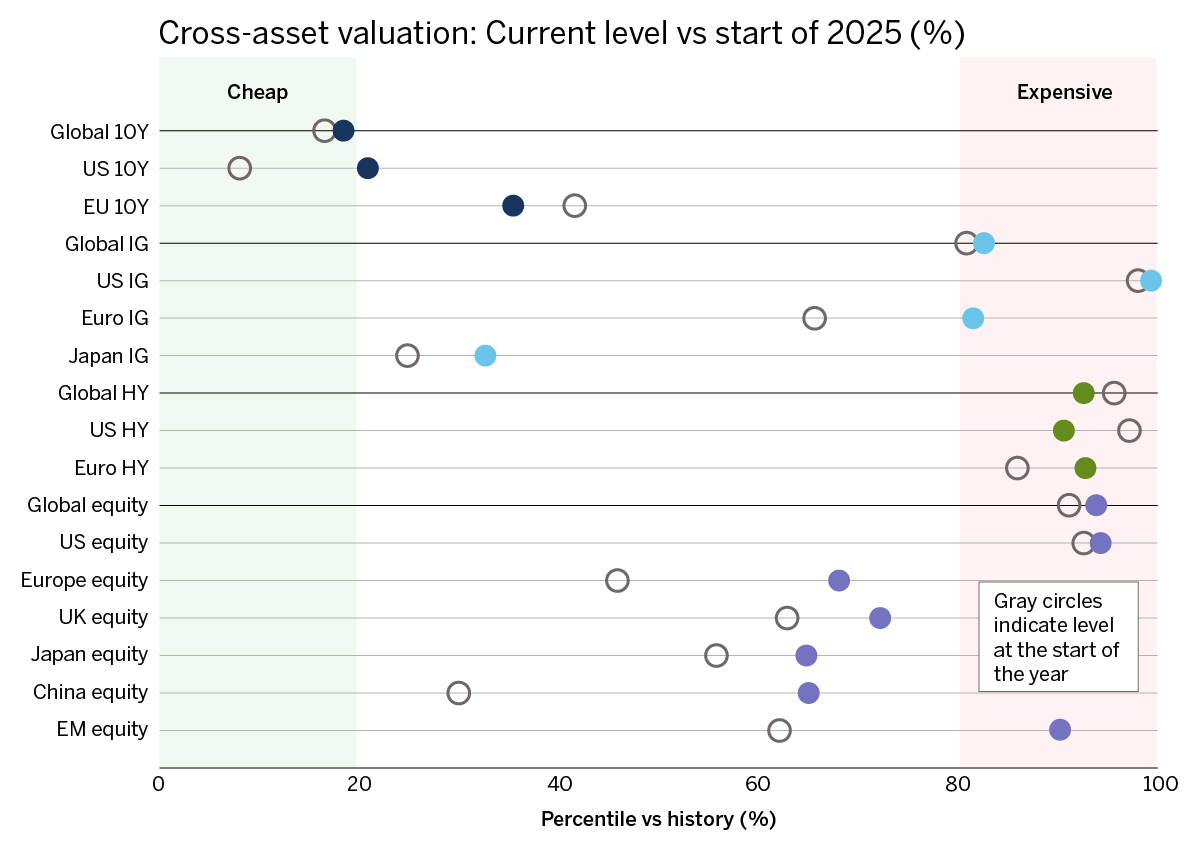
Sources: Wellington Management, Refinitiv | Equity valuation measured as percentile of forward 12-month price/earnings. Government bond valuation measured as percentile of 10-year yield. Credit valuations measured using percentile of credit spread. | Percentiles measured using weekly data from 7 September 2003 to 3 August 2025. | Information presented contains forward-looking statements. Actual results and occurrences may vary, perhaps significantly, from any forward-looking statements made.
Investment implications
- US equities have recovered as big tech earnings continue to deliver, buoying valuations ever higher. It may be a high bar for such expectations to continue, but ironically a weaker dollar may boost earnings of multinational companies, and fiscal stimulus and deregulation are factors to watch. Regional equities like China and Europe have had phenomenal year-to-date returns and while valuations now exceed historical medians, they are not yet considered expensive. Global equities have benefited as US confidence has faltered, but fiscal stimulus and reform measures have the potential to support continued growth. Maintain equity allocations with a slight pro-risk stance.
- Although global credit valuations are still expensive, entry-point yields remain attractive, and income continues to be the primary driver of long-term returns due to its consistency and compounding power. Global credit indices also tend to be more diversified in their sector composition than equities, with less exposure to industries that have more heavily driven overall index volatility, like tech.
- While valuation levels are often used to estimate long-term return potential — for example, high valuations today may imply lower returns ahead — they’re poor short-term signals. Valuations can remain elevated for years, and meaningful reversion to historical averages typically only occurs during deep market corrections. Over the long term, focus on companies and markets with sustainable earnings growth and consistent dividend payouts, as these are the structural return drivers.
What we are watching
- Evolution of consumer and company patterns in response to finalized tariffs. Potential valuation dispersion across markets and sectors may create opportunities for active managers to add value through selective positioning.
- Global fiscal stimulus and reform policy, particularly the effects of the US “One big beautiful bill” as well as European stimulus. Such measures may boost domestic growth.
- Global central bank policy recalibration and new inflation/growth print as tariff drags take hold. Steady inflation and resilient growth may give central banks a larger buffer to maneuver changing dynamics resulting from a downside tariff scenario.