


- Impact Measurement & Management Practice Associate
Austria (Österreich), Institutional
ChangeThe views expressed are those of the authors at the time of writing. Other teams may hold different views and make different investment decisions. The value of your investment may become worth more or less than at the time of original investment. While any third-party data used is considered reliable, its accuracy is not guaranteed. For professional, institutional or accredited investors only.
Impact investors aim to drive positive social or environmental change alongside competitive financial returns, but how can they ensure that the impact they are generating actually helps the intended beneficiaries? Data supporting the cause-and-effect relationship between an impact company’s activities and the desired social or environmental results — often called the theory of change — are essential inputs for impact investors. While identifying the desired impact data to measure can be straightforward, capturing insights from those experiencing a company’s products or services, is historically viewed to be difficult.
In this paper, we describe how Wellington’s Impact Measurement & Management (IMM) Practice incorporates the work of 60 Decibels, a social-impact measurement company, into its research on public microfinance companies.
While the impact investing industry increasingly recognizes the importance of incorporating the experience of end beneficiaries into their theories of change, discussions around assessing it often remain hypothetical. This is because capturing end-user feedback that can be translated to measurable key performance indicators (KPIs) is challenging, sometimes even impossible, for impact investors, as they are unable to reach and listen to thousands of consumers. This is reflected in the Global Impact Investing Network's (GIIN’s) survey result, highlighting that 94% of investors don’t engage directly with end stakeholders.1 The challenge is especially apparent for public-market impact investors, whose understanding of end-user experiences is often limited to information disclosed in publicly available documents and engagements with corporate management teams.
With regards to financial inclusion, research by the World Bank and others has shown that expanding financial access to historically marginalized individuals and small businesses can lead to numerous social and economic benefits.2 Greater financial inclusion enables communities to invest in health care, education, and business development, for example, fostering economic growth, financial stability, socioeconomic empowerment, and mobility. However, assessing and measuring this positive impact of microfinance investments on peoples’ lives — beyond the obvious benefit of expanded financial access — can be particularly unwieldy. Financial services providers (FSPs) often have thousands of customers, from households to entrepreneurs to small businesses, and many customers may lack reliable internet access, speak different languages, or be reluctant to discuss their use of microfinance products.
60 Decibels’ Microfinance Index aims to bring standardization, repeatability, and scale to customer-centric impact measurement in the financial inclusion space.3 Using a common set of questions across six dimensions — access, business impact, household impact, financial resilience, agency, and client protection — 60 Decibels has surveyed more than 86,000 microfinance borrowers served by 228 FSPs in more than 50 countries. This data has been collected via phone interviews conducted in more than 80 languages. The Microfinance Index has three primary objectives:
Learn more about 60 Decibels’ work.
Wellington’s impact teams invest across 11 impact themes, including financial inclusion. Our impact portfolios seek to generate attractive total returns by investing in innovative companies whose core products and services address some of the world’s major social and environmental challenges. For a financial services company to qualify for inclusion in Wellington’s impact portfolios, it must meet three criteria:
Our approach also includes an assessment of a company’s impact risk and any negative externalities on its customers and their communities.
Explore Wellington’s impact investing platform.
By integrating data and insights from 60 Decibels’ public Microfinance Index report into our proprietary impact criteria, Wellington’s IMM Practice has developed a framework for our firm’s public-market impact investors to utilize when assessing the social impact of microfinance companies. Specifically, we have developed targeted research questions using 60 Decibels’ findings that complement Wellington’s existing impact framework and improve our ability to recognize potential impact risks and sources of additionality. For example, for the additionality of a company’s financial products or services — the outcome that would likely not have occurred in their absence — the counterfactual is unknown, making assessment of a company’s additionality extremely difficult. Engaging directly with end consumers is challenging, especially for public-market impact investors. This difficulty heightens the skepticism about their ability to demonstrate additionality.
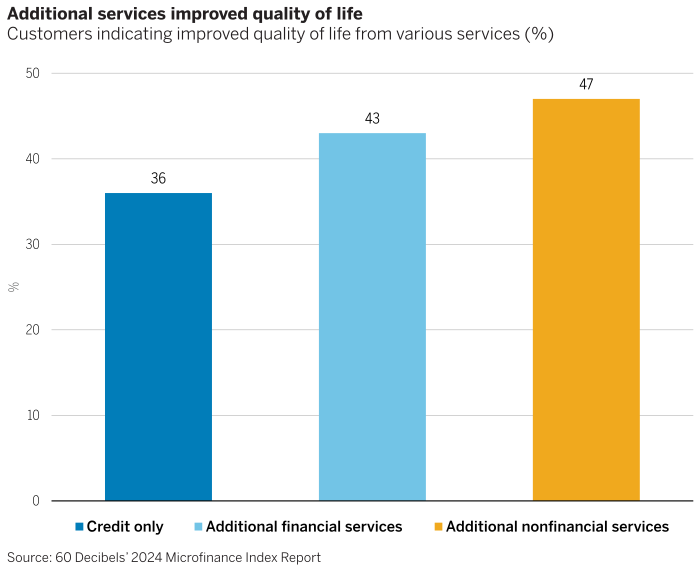
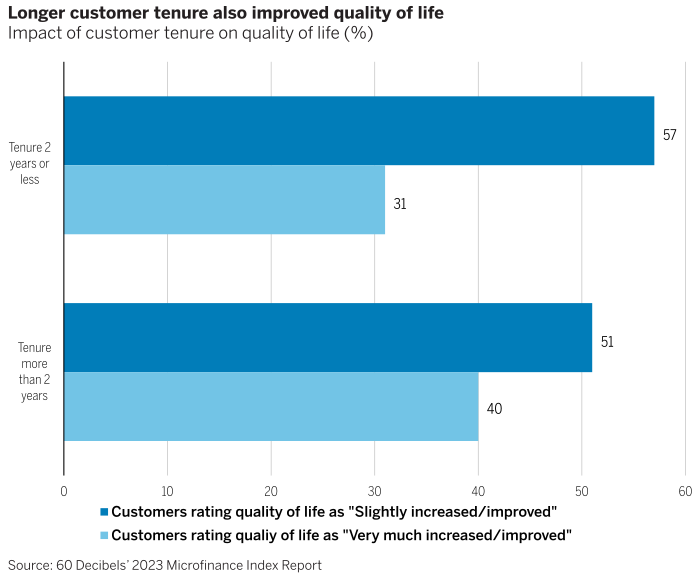
Our framework consists of nine research questions, each focusing on different criteria. For example, when analyzing a company’s product and service offering, we consider one of 60 Decibels’ key findings that additional services beyond credit — both financial and nonfinancial — can lead to improvements in quality of life, business income, and other benefits. Given that additional services beyond credit have the potential to deepen impact, investors should consider the entire product offering when assessing a microfinance company. For example, if a company offers additional nonfinancial services while its competitors in the region generally do not, this could be considered as indicative of deeper impact based on data from similar end users. Another important finding from 60 Decibels’ research is that longer-tenure customers tend to experience a deeper impact.
| Category | IMM research question and potential metrics | Data availability |
|---|---|---|
| Product or service offering | ||
| At an aggregate level, additional financial and nonfinancial services enhance customers’ personal, business, and household outcomes, leading to deeper impacts in life quality, business income, and financial management (Figure 1). | Does the company offer services in addition to credit? Look for/engage on:
| Very good; mainly available in company reports |
Figure 1
| Category | IMM research question and potential metrics | Data availability |
|---|---|---|
| Customer characteristics | ||
| Customers who have been with their FSP longer (more than two years) are more likely to report significant improvements in their lives and household welfare (Figure 2). | How long is the average tenure of customers? Is it more than two years? Look for/engage on: Average tenure of loans/other products | Good; mainly available through third-party data |
Figure 2
A determining factor for the IMM Practice in using this framework was the availability of data in publicly available documents. Data availability and reliability remain core hurdles to building trust and attracting assets in public-market impact investing strategies.4 For each research question, the IMM Practice rated how easy it was to obtain quality data. We discovered that companies’ annual reports and sustainability reports, along with third-party data, supplied most of the necessary information to address our research questions.
Engaging with end beneficiaries is a challenging but important task for impact investors, who aim to discover competitive investments and ensure impact integrity. This feedback can help institutional investors and fund managers seeking to drive meaningful impact and minimize unintended harm. We believe the impact - both positive and negative - of financial inclusion is better understood by listening to those experiencing that impact. The more closely connected we are to the lived experiences of end users, the better microfinance companies can design products and services that advance financial inclusion and social impact.
For public impact investors, direct contact might be impossible, but creative methods can be utilized to incorporate their perspectives into the real impact of the investment. Wellington’s IMM Practice has focused on turning 60 Decibels’ data into clear research questions and delivering an easy-to-use tool that Wellington’s public impact investors may apply to their investment process. As new investment opportunities emerge in microfinance, the IMM Practice will continue to help impact investors leverage this framework to demonstrate additionality and identify potential impact risks. Capturing data-driven end-beneficiary feedback is, in our view, consistent with Wellington’s fiduciary duty in its impact investment approaches to deliver excellent returns for clients via competitive investment opportunities
It is encouraging to see Wellington’s IMM incorporating these insights into their research and investment strategies. By asking questions that draw from key findings in 60 Decibels’ public reports, into due-diligence processes and portfolio management, investors can better identify companies reaching the most vulnerable people and delivering the deepest impact.
1 IMM Practice Insights, GIIN, 2023 | 2 Financial inclusion overview, World Bank Group. | 3 “Social performance insights, powered by client voices,” 60 Decibels, 2023. | 4 “Why data can ensure the whole world benefits from impact investing,” World Economic Forum, 5 January 2024.
Experts


Contributor