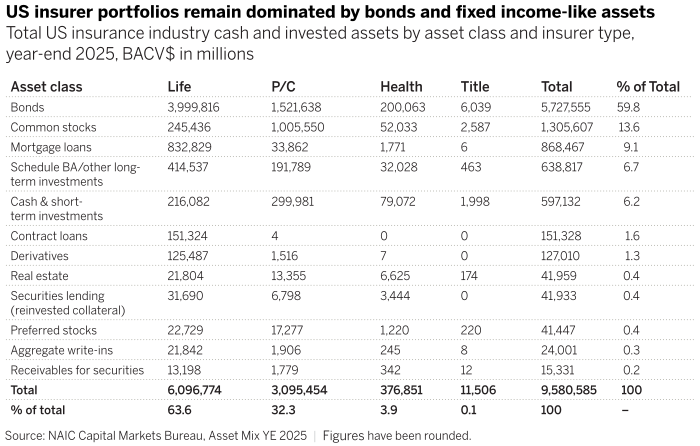
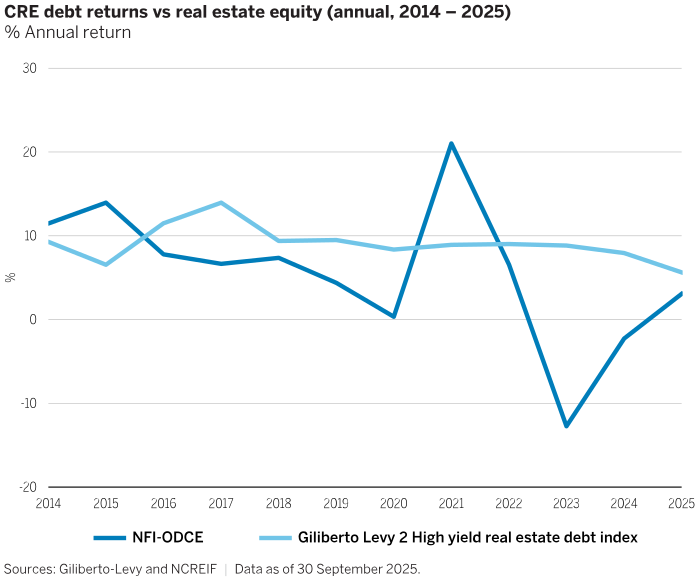
Taken together, transitional CRE debt can serve multiple strategic roles in an insurance portfolio: a complement to corporate-credit-oriented fixed income, a diversifier within private credit, and a way to access real asset value creation with the potential for stronger downside protection than equity.
Diving deeper on classification and capital considerations
For allocators who find transitional CRE debt’s investment case compelling, the next practical question is how an allocation fits within an insurer's regulatory and reporting framework.
Private CRE debt insurance allocations typically sit at the intersection of private credit and real estate. Because these transactions are privately originated, the asset class falls within the broader private credit universe alongside corporate private credit, asset-based finance, and residential real estate debt, among others.
At the same time, for US insurers, private CRE debt is generally categorized as real estate in regulatory reporting rather than grouped with corporate or asset-based private credit. In practice, individual CRE debt positions, such as those held in separately managed accounts, are typically classified as commercial mortgage loans on Schedule B, while LP interests are generally reported on Schedule BA as other long-term assets — real estate. As a result, insurers often discuss CRE debt as part of their private credit allocation from an investment standpoint, while treating it as part of their real estate exposure for regulatory and reporting purposes.
In our view, this distinction matters for portfolio construction. For insurers with meaningful existing CRE holdings, private CRE debt may offer a way to diversify real estate exposure across regions, property types, and asset conditions, including transitional assets. Importantly, they can do so while still potentially benefiting from key private credit attributes, such as: potential yield pickup and illiquidity premium, structural seniority, covenant protection, and the ability to negotiate and actively manage through stress situations.
Capital treatment remains an important consideration, but we believe it is best evaluated in the context of the specific implementation vehicle and local regulatory regime. Across jurisdictions, capital treatment broadly rhymes, even if the exact weighting differs based on regulatory objectives. That said, due to CRE debt’s contractual income, structural seniority, collateral backing, and more defensive attachment points, we believe the underlying risk profile can compare favorably with many other private asset classes. On that basis, we think CRE debt can offer a relatively capital-efficient way to access private market income compared with more equity-like exposures. Actual treatment will depend on the applicable regime, the implementation vehicle, the extent of look-through, and how leverage is recognized.
CRE debt risks to consider
CRE debt allocations carry potential risks that insurers should size and manage carefully. These assets are influenced by execution of the underlying asset business plan, including leasing progress, capital programs, and timing, and outcomes can vary across managers based on sourcing, structuring, underwriting, and asset management capabilities. As a private market allocation, it is also less liquid than public market alternatives, and appraisal-based valuations may adjust more gradually than traded markets. Regulatory and internal guidelines may further shape implementation through concentration and exposure limits.
Bottom line
Insurers accessing transitional CRE debt may benefit from contractual cash flow, floating-rate structures, collateral backing, and a broad opportunity set supported by traditional banks reallocating and rebalancing their CRE exposure, reset valuations, and a multi-year maturity wall. In our view, the asset class can offer a differentiated mix of current income, downside protection, diversification, and potential capital efficiency relative to more equity-like real estate exposures.